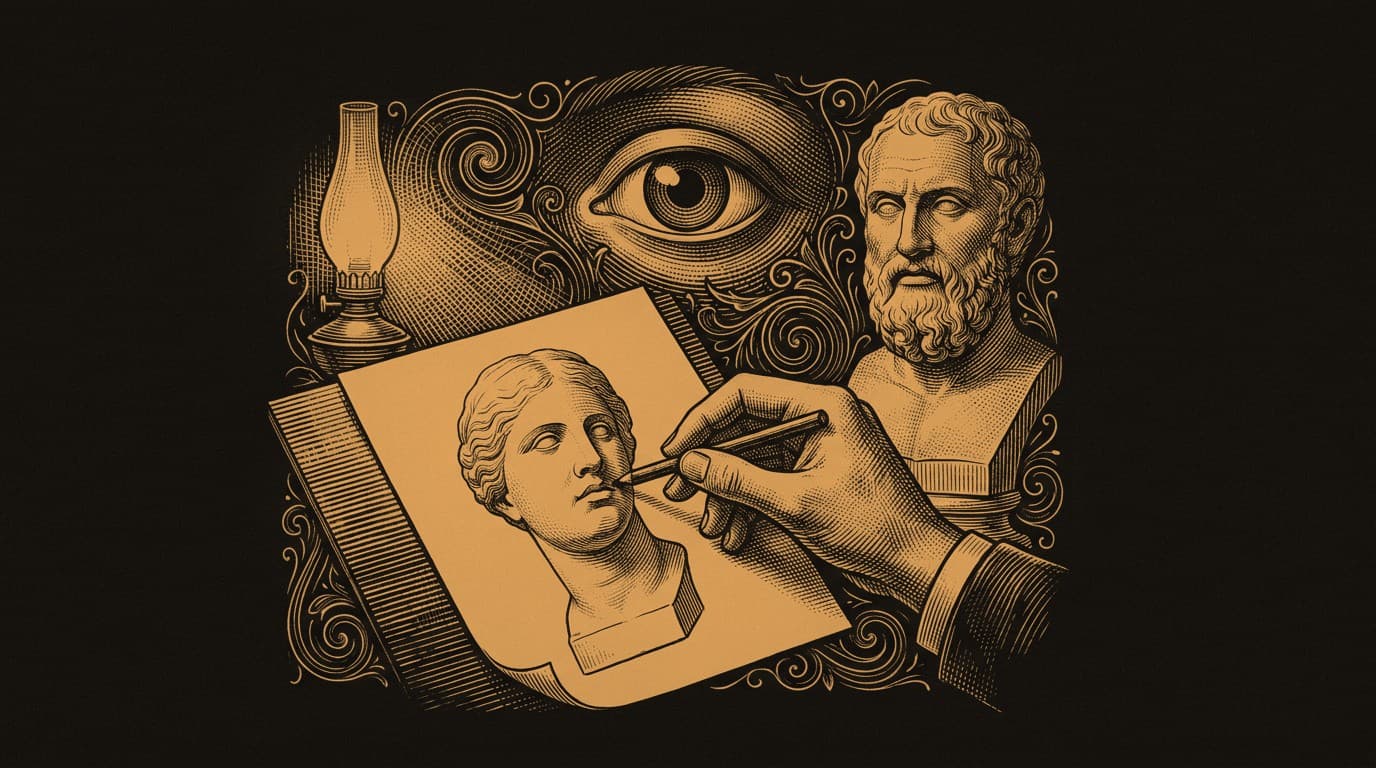
Before an art student in the nineteenth century was allowed to draw a living model, he spent the better part of a year copying plaster casts of statues that were themselves copies. White casts of dead marble, under fixed light, drawn and redrawn. Copy a master's drawing, then copy the cast, then copy it again, the same shoulder for the fortieth time. It looks like the most pointless curriculum ever designed.1
The drawings were never the point. The eye was. You cannot see a wrong proportion until your own hand has made enough of them, and the cast was a cheap, patient, unmoving thing to be wrong against. By the time the student reached a live model he could see, and he could see because of everything his hand had ruined first. Knowledge informs observation: you perceive what you have learned to construct. The drawing trained the eye, and almost no one in the room could have told you that was the thing being built.2
Hold that, because we are about to remove the hand, keep the eye, and assume the eye still works.
When an agent writes the code, your job becomes reading it. You specify, it generates, you review, you approve or send it back. The making is gone and the judging remains, and it looks like a clean trade: keep the valuable half, shed the typing. The whole pitch of the era is that you have been promoted out of the drapery and into pure judgment.
But judgment was never a thing you brought to the work. It was a thing the work built in you.
Every wrong proportion you ever drew, every off-by-one you chased for an hour, every abstraction that felt clever on Friday and read like a confession on Monday: that was the cast. That was the hand making the eye. You learned to feel a design going wrong before you could say why, and you learned it the only way anyone ever has, by being wrong in contact with the material until the pattern went under your skin. A senior engineer's "this smells off" is not a gift. It is a thousand ruined drawings.
Now run it forward. If the making is done through an agent, the eye stops being fed. You can review for a decade and never once draw the cast.
And there is a worse problem than a hungry eye, which is what the hungry eye starts grading instead. Detached from the material, judgment cannot reach correctness, because correctness lives in contact with the thing: does it run, does the data have that shape, does the edge case occur. From above the work, the only thing you can assess is plausibility. Does this read like good code. Does the explanation hang together. Does it look like the kind of thing that is right.
A fluent collaborator is a machine for producing plausibility. That is exactly what a model is. It is fluent in the right answer and fluent in the wrong one at the same finish, because the finish is the product. So an eye trained only by review, grading plausibility because plausibility is all it can reach, is being tuned to the precise signal that a confident, fluent, sometimes-wrong collaborator throws off for free. You are not only starving the eye. You are retraining it to be fooled.3
There is one thing in software that does not care how plausible your code is. It runs it. The test that fails, the program that crashes, the production line that bends the wrong way: that is the cast. It is indifferent to fluency. It is the last surface that forces judgment back into contact with reality instead of with the appearance of it. One sentence carries the whole argument: the test suite is where persuasion becomes checked.4
So the move is not to review more. Reviewing more sharpens the wrong eye. The move is to keep making contact with the part that can be wrong in a way no one can talk around. Run the thing yourself. Write the test before you read the agent's version, so your judgment is anchored to behavior and not to prose. Keep one hand on the cast on purpose, even when the agent could draw it faster, because the drawing was never the point.
The studio's real curriculum was always hidden inside its busywork. Copy the cast, paint the drapery, grind the pigment: it all looked like the cost of making the art, and it was secretly how the maker got made. We are close to automating the busywork, keeping the art, and calling it efficiency, which is what you would call it if you had never noticed the busywork was load-bearing.
So keep drawing the cast. Not all of it, and not for nostalgia, but enough, on purpose, that the eye stays fed on something real.
Because the alternative is an eye that has only ever been shown plausible things, made the last line of defense against a machine whose one talent is plausibility.
The hand was never in the way of the eye. The hand was where the eye came from.
Notes
-
The nineteenth-century academic sequence ran from copying master drawings, to drawing plaster casts of classical sculpture, to drawing from the live model, in that order and often over years. Cast drawing was the long middle, and it was defended precisely as training in seeing, not as decoration. Getty, "The Art of Learning to Draw"; Sight-Size, "Why Cast Drawing?"; Jackson's Art, "The History of Cast Drawing" ↩
-
"Knowledge informs observation" is the atelier's own phrasing of the principle that perception is trained, not given: the exercises build an analytical way of seeing shape, proportion, and form that the untrained eye lacks. The honest narrower claim is that making is one reliable way to train the eye, not the only conceivable one; exposure, stakes, and feedback might in principle be supplied some other way. No one has yet shown a substitute that works at scale, which is the same shape of bet as tearing out a hierarchy before building whatever was supposed to replace the apprenticeship. Sight-Size, "Why Cast Drawing?" ↩
-
Agents "produce plausible output," and the documented new requirement is to evaluate work you did not write, where a plausible surface can hide a race condition or a subtly wrong query. An evaluator who can only assess surface is defenseless against a generator optimized for surface, which is the structural reason "review harder" is not the fix. Google Antigravity 2.0 and the author-to-director shift ↩
-
The line, and the larger account that the model "moves the burden from typing to deciding" while the test suite remains the place where "persuasion becomes checked," is from a working engineer writing about coding alongside agents in his own IDE. Josh Lospinoso, "The Workshop Has Changed" ↩