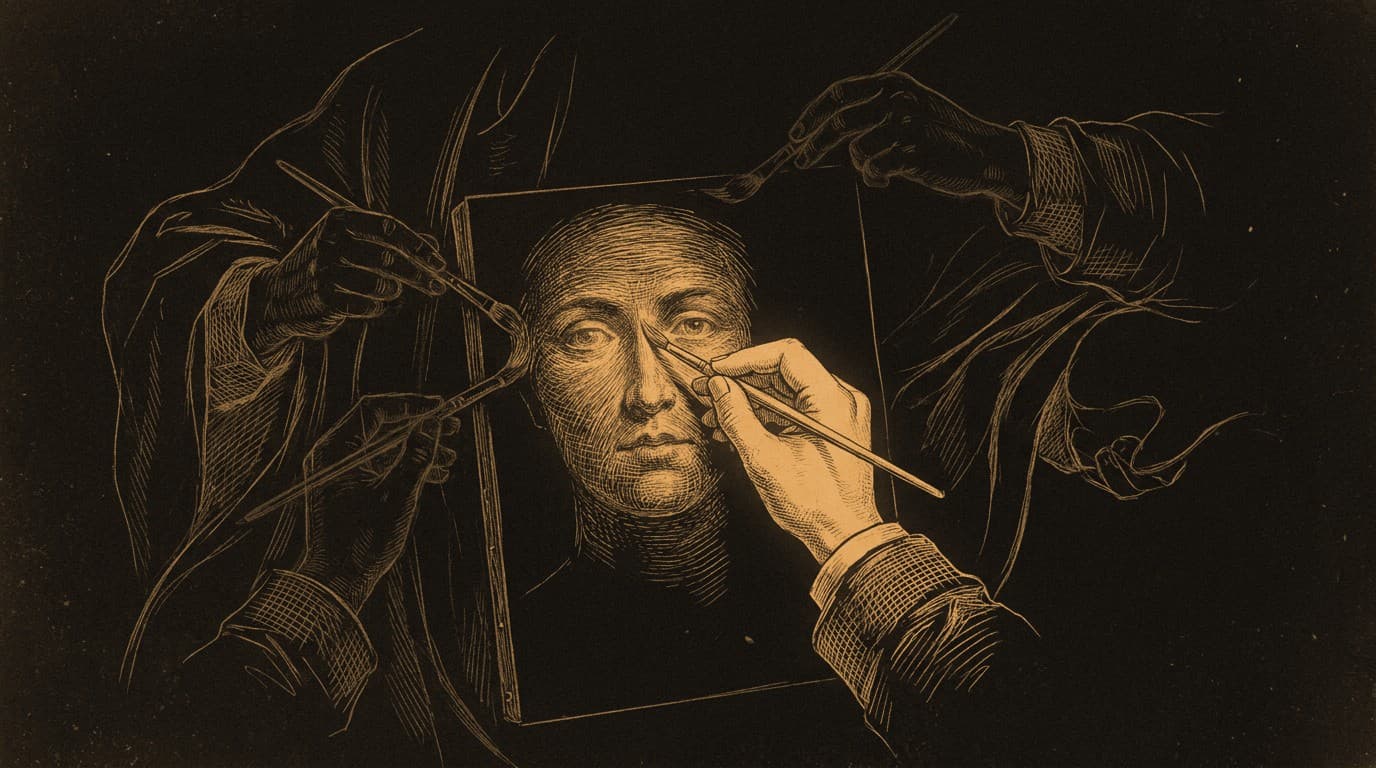
In a Renaissance workshop the master did not paint the whole picture. He painted the faces and the hands and left the robes, the sky, and the floor to the apprentices. Look at Verrocchio's Baptism of Christ: the passage everyone now gives to the young Leonardo, painted while he was an apprentice in the shop, is a kneeling angel's robe. Verrocchio kept the two main figures. The pupil got the cloth.1
This was not vanity, and it was not rank for its own sake. It was triage. The face is where the eye lands and where a fake is caught. A wrong hem is invisible to everyone; a wrong face is obvious to a child. So the master kept his brush on the strokes that carried the verdict and gave away the strokes that did not.
You are about to run a workshop like this, whether you meant to or not.
The agent paints fast and paints everything. The only decision it leaves you is the one the master made every morning: which strokes do you keep your own hand on, and which do you hand off?
The instinct is to keep the fun part. You take the greenfield, the clean new module, the feature with no history, and you let the agent do the boring glue: the wiring, the migration, the plumbing between services. It feels right. The glue is tedious and the greenfield is where the thinking seems to be.
It is exactly backwards.
Greenfield is drapery. It is voluminous, low-stakes, and cheap to repaint. If the agent gets a fresh self-contained module wrong, you delete it and regenerate, and nothing downstream has inherited the mistake, because nothing downstream exists yet. The robes can be redone a dozen times and the painting is none the worse.
The glue is the face. A contract between two services, a data model that quietly encodes an assumption, a migration that is subtly lossy: these are the strokes everything else hangs on. Get one wrong and the error does not stay where you made it. It propagates into every piece that trusted it, and you meet it again a month later wearing a disguise. That is a wrong face. It is the part where the composition holds together or comes apart.2
So here is the rule, and it is sharper than "keep the important parts," because in the agent era everything you are handed looks important and looks finished. The face is wherever plausible and correct come apart. A model's output is uniformly plausible. It is fluent in the fresh module and fluent in the migration and fluent in the error path, all at the same finish, because fluency is the product. Your judgment is worth nothing where plausible and correct already agree, which is most of the drapery. It is worth everything in the few places where something can read perfectly and still be false: where the new code has to be right about something it cannot see. The rest of the system. The production data. Last year's decision. What the user meant.3
Those places are the faces. Paint them yourself.
Notice what this costs you, because this is the part people refuse. It asks you to hand the agent the work you find interesting and keep the work you find dull, because interest and stakes have come apart too. The master did not keep the faces because faces were fun. He kept them because they were where he could be caught. Delegating by what you enjoy is how you end up hand-crafting a CRUD endpoint while an agent quietly reorganizes your data model, which is a master lovingly painting the sky while an apprentice signs his name to the faces.
It also asks you to let go. The master who insists on painting every robe himself is not a craftsman. He is a bottleneck who never ships the commission. Letting the agent paint the drapery is not laziness; it is the workshop working as designed, the same design that let one shop in Florence make more than one pair of hands ever could. The skill was never doing all of it. The skill was knowing the difference.
That difference is the whole job now. The work is no longer doing the work. It is reading a task, finding the two or three places where plausible and correct diverge, and putting your hand on exactly those while the robes paint themselves.
So before you hand anything to an agent, find the faces first. Say them out loud: here, and here, and here, the contract, the migration, the seam. Paint those. Give the rest away with both hands.
The catch is that finding the faces is itself a skill, and it used to come free with ten years of painting drapery. Pull the drapery out from under people and the eye has to be grown some other way, which is the harder problem and a longer story.
An apprentice is known by how little he is allowed to paint. So is an agent. The faces stay yours.
Notes
-
Verrocchio's Baptism of Christ (c. 1475), now in the Uffizi. The workshop convention was that the studio head designed the work and painted the principal figures, leaving secondary passages to pupils; here the young Leonardo, then an apprentice, painted the far-left angel and reworked part of the background landscape, and at least one other unnamed assistant painted other passages. The collaboration is the standard textbook case of the bottega division of labor. Wikipedia; Uffizi Galleries ↩
-
That integration, not invention, is where the work now concentrates is a recurring finding in the orchestration writing: the time saved producing components reappears when aligning them into one maintainable system, so integration "becomes a central task" rather than an afterthought. Geoff Eldridge, "The Programmer as Orchestrator" ↩
-
The failure mode is documented plainly. Agents "produce plausible output," and the engineer's new burden is to become "a skilled evaluator of outputs they did not personally write," catching the inconsistently parameterized query or the race condition that reads as fine. Plausibility is uniform across an agent's work; correctness is not, and the gap between them is exactly where review has to concentrate. Google Antigravity 2.0 and the author-to-director shift ↩